A prompt isthestartofyourinteractionwith an AI. However, theresultsofthisinteractioncanvarygreatly. The qualityoftheanswerscanbeimprovedbyusingsuitable prompt methods and adheringtoimportantrules. Wehavesummarized essential basicinformationforyou and hopeyouenjoyusingthetips and methodsforyournext prompt.
Important building blocks for clear prompts
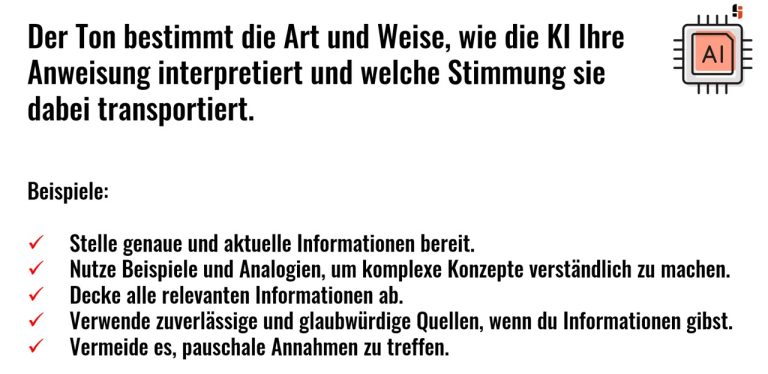
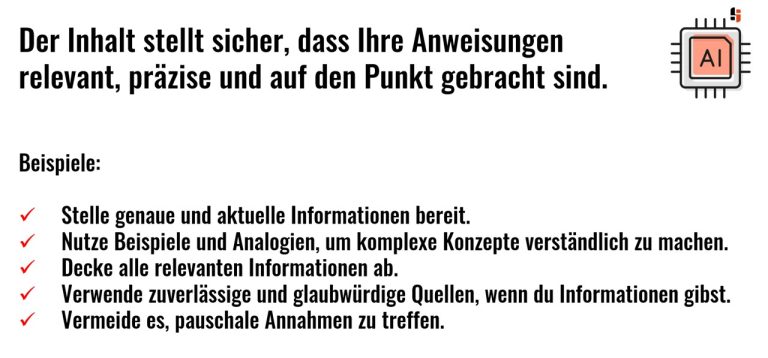
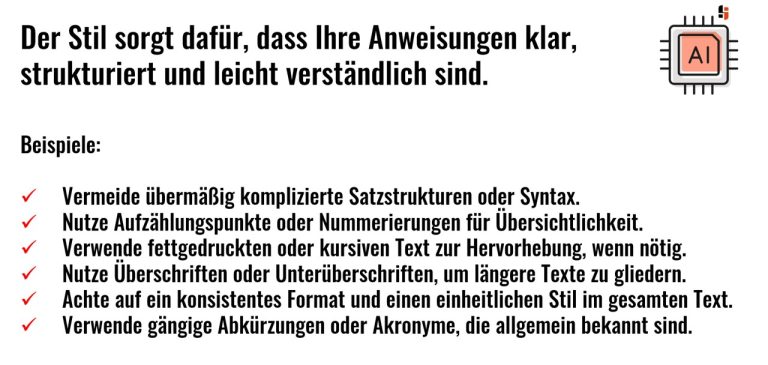
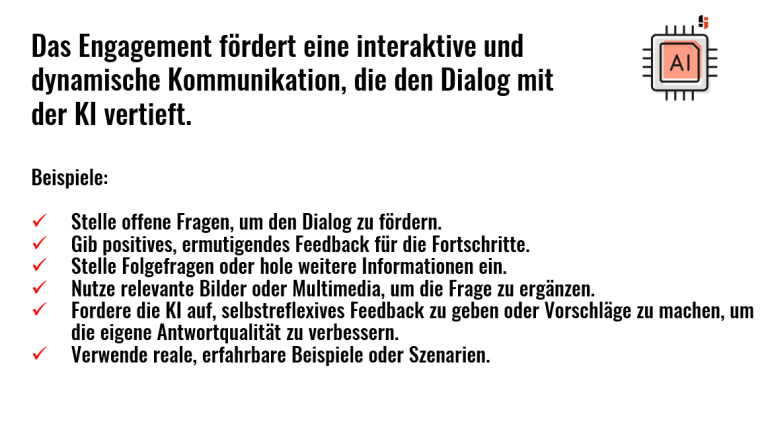
The quality of the results you receive from an AI depends largely on how clearly and precisely your instructions, also known as prompts, are formulated. This one-pager presents four central building blocks - sound, content, style and engagement - which help you to create targeted prompts and achieve the desired results.
Each of these building blocks plays a specific role:
Prompt methods
Prompt methodsserveas a guidetocreatingeffectivepromptstogetbetterresultsfromthe AI. Therearemany such methods, but itis not necessarytoknowthem all. Wehavesummarizedsomemethods in a compact form and presentthemindividually.
A prompt is the specific input or question that you ask an AI in order to receive a specific answer or action. It is, so to speak, the command or instruction that you give the AI. A well-formulated prompt is clear and precise in order to get the best possible response from the AI.
Prompting , on the other hand, is the process or method by which you create and use these prompts. It covers the techniques and strategies you use to formulate effective and useful prompts. Prompting is therefore the overarching term that describes the entire process of creating and using prompts.
To summarize: A prompt is the specific input, while prompting is the process of creating and using these inputs.
Dos and don'ts when prompting
The resultofyourconversationwithan AI dependsheavily on the prompt itself in all itsfacets. Howisitformulatedlinguistically and stylistically? Are thecontent and objectiveclear? In principle, thefollowingapplies: The clearertheinstructions and communication, thebettertheoutput. But yourbehavior also plays an importantrole, forexample in thewayyouconductconversations.
Formulate clearly and precisely
Give examples
Be polite
Observe punctuation and grammar rules
Hold a conversation (give feedback, add details, refine the result)