
Microsoft 365 Copilot: Your Scheduled Prompts are now Editable

Scheduled prompts in Microsoft 365 Copilot already take the repetition out of routine tasks — and now you can edit existing ones directly instead of setting them up from scratch. For weekly reports, daily briefings, or status checks, that means adjusting the prompt, shifting the time window, changing the frequency, or toggling notifications without losing what you’ve already built. Here’s how it works and where it makes the biggest difference.

 

Info Value: Flexible routine management
UseCase Use Case: Reports, briefings
Zeit Read time:
3 minutes
Schwierigkeit Difficulty: Beginner

This feature marks a meaningful step toward Copilot working more proactively in the background. Instead of typing the same prompt every morning, tasks run automatically — and you only need to step in when something changes. That’s exactly where editing comes in: your existing routines stay intact, but can be quickly adjusted whenever schedules or priorities shift.

A couple of prerequisites worth knowing upfront: you’ll need a Microsoft 365 Copilot licence, and “Optional connected experiences” must be enabled in your settings. Without that, the feature won’t be visible. Everything runs within the Microsoft 365 and Copilot environment and is managed by Microsoft services — those settings are what govern both availability and control.

  1. Open Copilot Chat in your browser at microsoft365.com/chat, or via Microsoft Teams or Outlook.
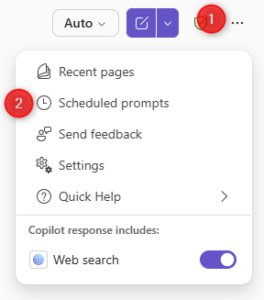
  2. Click (Copilot chats and more) in the top right and select Scheduled prompts.
  3. Select an existing entry and click Edit schedule.
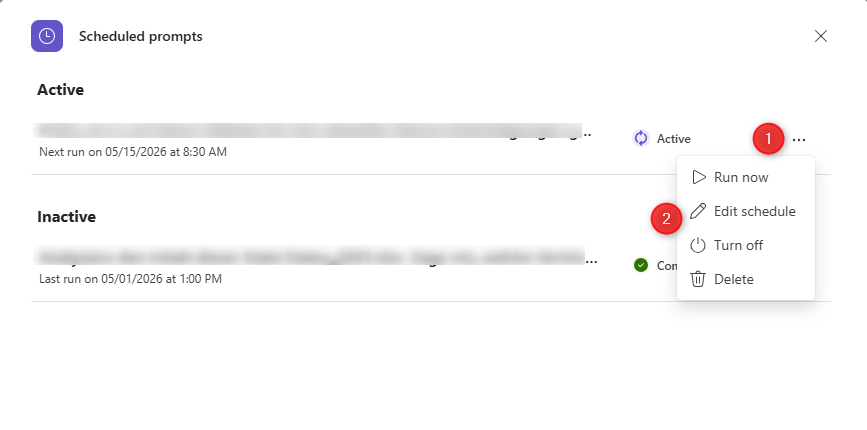
  4. Update the prompt text itself, or adjust when and how often it runs. You can also enable or disable email notifications for this prompt here.
  5. Confirm with Update. Additional options including Pause and Delete are also available from this view.
  • Licence & settings: Requires a Microsoft 365 Copilot licence with “Optional connected experiences” enabled. The feature won’t appear without it.
  • Watch your notifications: Email alerts are useful, but can pile up quickly. Be intentional about which prompts actually need them.
  • Verify the output: Results depend on the underlying data. For automated reports in particular, a quick sense-check before sharing is always worth it.
  • Start with a weekly report: A fixed schedule and a clear output — ideal for seeing the benefit immediately without much setup.
  • Use “Run now” to test changes: After editing a prompt, trigger it manually to check the result before the next scheduled run.
  • Name prompts clearly: Something like “Sales Report Monday 8am” beats “Report” — saves time hunting through the list later.
  • Be selective with notifications: Only switch them on for prompts where the result genuinely needs your attention — keeps your inbox under control.
  • Start with a lower frequency: It’s easier to increase the cadence once you know what’s useful than to dial back a flood of outputs.

Editable scheduled prompts bring exactly the kind of flexibility that was missing. Routines stay in place, but can be quickly adapted when schedules shift or priorities change — and that adds up to a noticeable reduction in manual overhead over time.

For teams with recurring tasks, the entry point is straightforward: open an existing prompt, adjust the schedule or the wording, and run it once to check. It’s a small step, but a clear one in the direction of Copilot as a reliable background worker rather than just a chat interface.